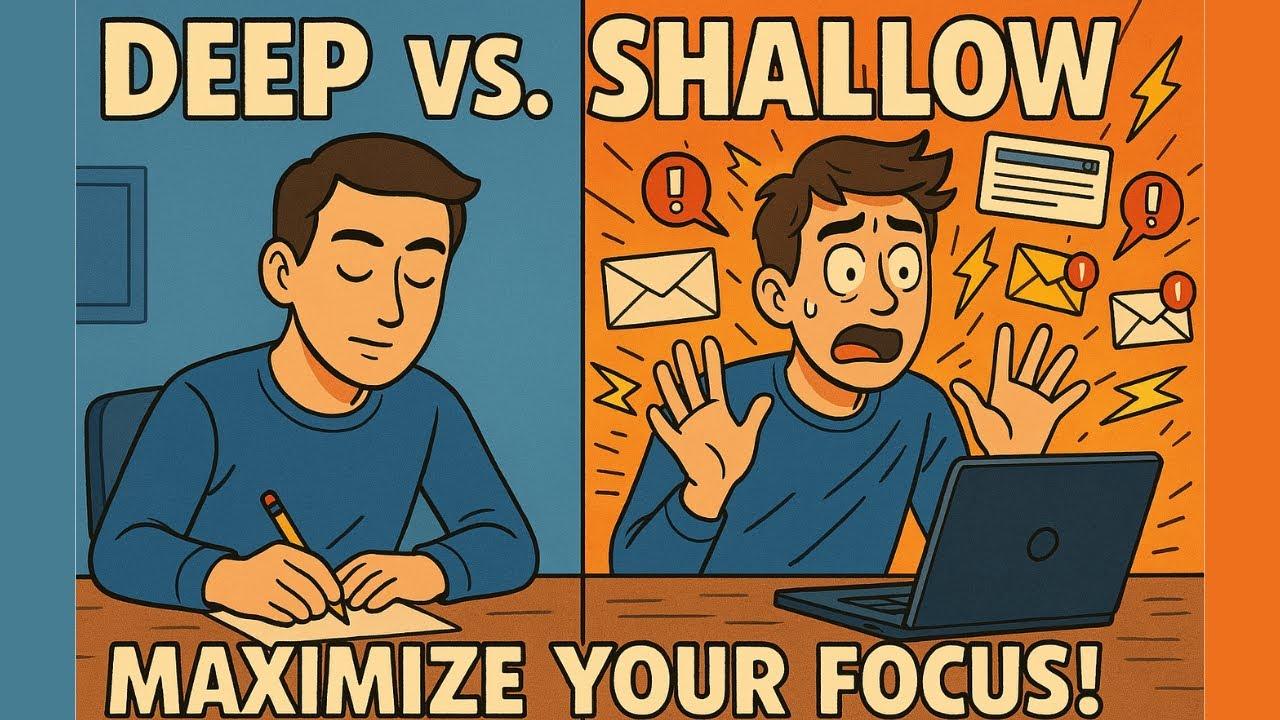

You’re Not Lazy, You’re Just Distracted.

Let’s be honest. Your average workday is a chaotic mess of good intentions.
You sit down with your coffee, ready to tackle that big, important project. Five minutes in, a Slack notification pings. Then an email lands—URGENT. You open a new tab to “quickly” check something. An hour later, you’ve got 17 tabs open, you’ve answered three emails that could have waited, scrolled through a feed you don’t even like, and the cursor on your actual project is still blinking, mocking you.
You end the day feeling drained, like you’ve been running a marathon, but the finish line is further away than when you started.
This isn’t a personal failing. It’s the default state of modern work. We’re caught in a frantic cycle of “shallow work”—the busywork, the pings, the meetings that could have been emails—that feels productive but produces very little of real value.
The fix isn’t another productivity app. It’s a mindset shift Cal Newport famously called Deep Work:
The ability to focus without distraction on a cognitively demanding task.
In an age of AI-generated content and constant noise, the ability to do real, focused thinking isn’t just a skill. It’s your most valuable currency.
Why You Should Actually Care About This
Let’s cut the fluff. The benefits of deep work aren’t about “optimizing synergy” or whatever buzzword is trendy this week. It’s about three things that actually matter:
- Producing Work You’re Proud Of: The stuff that gets you noticed, that solves hard problems, that feels like a real accomplishment—it only happens when you give it your undivided attention. You can’t write a brilliant line of code, craft a compelling strategy, or create a piece of art in the slivers of time between notifications.
- Staying Relevant: The world is changing fast. AI is coming for the shallow tasks. Your long-term career security depends on your ability to learn complex skills quickly. Deep work is how you do that. It’s intense, focused learning on steroids.
- Not Hating Your Job: Seriously. The feeling of being constantly pulled in a million directions is a recipe for burnout. The state of “flow” you achieve during deep work isn’t just productive; it’s deeply satisfying. It’s the difference between ending your day feeling frazzled and ending it feeling fulfilled.
Find Your Rhythm: Deep Work Isn’t One-Size-Fits-All

Don’t let some productivity guru tell you that you have to lock yourself in a cabin for a month. That’s not realistic. Find a style that fits your life.
- The On/Off Switch (Bimodal): You dedicate specific, chunky periods to deep work. Maybe you go dark every Friday to focus on a project. Or you take one week every quarter to go deep. It’s about creating a clear separation: now I’m available, now I am not.
- The Daily Habit (Rhythmic): This is the most practical for most people. You build a consistent, daily ritual. Block out the same 90 minutes every single morning, no exceptions. It becomes automatic, like brushing your teeth. Your brain learns that from 8:00 to 9:30 AM, it’s game time.
- The Pro-Level Ninja (Journalistic): This is for the obsessively disciplined. It means grabbing any unexpected pocket of free time—30 minutes between meetings, an hour when a call gets canceled—and immediately dropping into a state of deep focus. Honestly, don’t even try this until you’ve mastered one of the others.
A No-BS Guide to Getting Started
Theory is nice. Action is better. Here’s how to actually do it.
1. Defend Your Calendar Like a Fortress. Don’t “find” time for deep work; make time. Block it out in your calendar as if it’s the most important meeting of your day—because it is. If someone tries to book over it, your default answer is “No.” Be ruthless about protecting this time.
2. Create Your “Go” Signal. Your brain needs a trigger to know it’s time to switch modes. Don’t just sit down and hope for the best. Build a simple pre-game ritual. It could be as easy as:
- Put on noise-canceling headphones.
- Make a specific type of coffee.
- Clear your desk of everything but your essentials.
- Open only the one app you need.
This little routine minimizes the friction of starting.
3. Go Nuclear on Distractions (Seriously). This is where most people fail. “Silent mode” is a lie.

- The Phone: Don’t put it face down. Don’t put it in your pocket. Put it in another room. The mere physical presence of your phone fragments your attention. Get it out of sight.
- The Computer: Close every tab that isn’t essential for the task at hand. Shut down your email client. Quit Slack, Teams, Discord, all of it. Use a site blocker like Freedom if you don’t have the willpower. Be unreachable. If it’s not on fire, it can wait 90 minutes.
4. Re-learn How to Be Bored. We’ve trained our brains to be dopamine junkies. The second we feel a glimmer of boredom, we reach for a screen. You have to break this addiction. The next time you’re waiting in line or sitting on the couch for a minute, just sit there. Be bored. Stare out the window. It feels weird at first, but this practice rebuilds your attention span so you can tolerate the focused effort of deep work without needing a distraction fix.
5. Create a “Shutdown” Airlock. Your brain will keep chewing on work problems all night if you let it. At the end of your workday, perform a shutdown ritual. Look at your to-do list for tomorrow, close all your tabs, tidy your space, and then say something out loud like, “Work is done.” It sounds silly, but it creates a clear psychological boundary that allows your mind to truly rest and recharge.
It’s Messy. Start Anyway.
You will fail at this. You’ll plan a deep work session and get pulled into a crisis. You’ll get distracted by a “quick look” at Twitter. It’s fine.
The goal isn’t perfection; it’s intention. Start with one 60-minute block this week. One hour where you are completely, gloriously unreachable. The clarity and progress you make in that single hour will be all the proof you need. Stop being a victim of your inbox and start doing the work that matters.